Above and Beyond

“Can architecture, in its built form, anticipate the conditions under which it will be viewed? If so, how should one proceed with its design?”*1
This question, posed by Stanislaus van Moos when discussing the relationship between Herzog & de Meuron’s architecture and Thomas Ruff’s photographic interpretations of it, is of particular relevance to us. Can we, as architects, in fact anticipate and articulate that?
Perhaps, before getting to this question we have to formulate another one: Are architects genuinely concerned with how their buildings will be perceived? Is that a common intention associated with the act of thinking architecture?
For most artistic disciplines, engagement with the audience is a core aspect of creation. However,in architecture, a building often just “sits” in its environment without actively engaging in a direct dialogue with its users. This does not imply that architectural works lack depth, connections or partial associations to larger artistic movements, philosophical ideas, contexts, authors and/or specific buildings with a designated place on the history of architecture. In fact, it implies almost the opposite—that they often do, but are generally associated with a certain pretension of intellectual exclusivity, an if you know, you know attitude that aims to reach only the few, often conveying more about the architect’s cultural references than fostering a meaningful connection with the public.
This tendency often leads to the perception that clients seek architects only as planners, not creators. They hire them for the plans, not the vision that could bring their needs and desires to life. As Oliver Lutjens often says, “We are planners; you pay for that... the architecture you get for free.”*2
We can certainly testify to this reality.
Other art forms engage their audiences more directly. Tarantino believes screenwriting and direction are about getting the audience involved. In Pulp Fiction, the non-linear story keeps the viewer focused and intrigued. It is written in that way in order to keep us hooked.*3 Hours, weeks, maybe months after watching Inception, we’re still wondering what the ending means. Same with Triangle of Sadness. The ambiguity keeps us thinking. It makes us feel, and we interact with that feeling.
Pop artists took signs and symbols we all knew, placed them in new contexts, and made them feel different. It was all about provoking a reaction. They made us think. The same object, in a new light, became something new, though it was still the old object that we used to know. This emotional engagement wasn’t just in movements that used popular signs. It was in Abstract Expressionism too. Rothko never wanted to talk much about his work.*4 He wanted each person to feel something, to find their own meaning in them. For him, it was always about the viewer’s connection. That was the point of making the work.
The emotional engagement isn’t limited to the visual arts. Music also uses familiar cultural references and emotional imagery to establish connections with listeners. Alex Turner’s lyrics in Arctic Monkeys’ “I Wanna Be Yours” resonate with collective cultural symbols - “I wanna be your vacuum cleaner, breathing in your dust, I wanna be your Ford Cortina, I will never rust”.*5 The use of precise cultural symbols evoke something deeper, tapping into our understanding of those symbols and creating an emotional pull that feels both familiar and striking.
The collective memory of any given society, the archive of a people’s desires, fears, and contradictions, has long been used in many art forms to create depth, ambiguity, and desire. Reworking the symbols, twisting the narratives. But in architecture it feels different. Aside from the flashy postmodern works, most buildings don’t try to engage with that collective memory or connect with the people who use them.
Buildings are often a monument to an idea, not to the people who move within its walls.
-
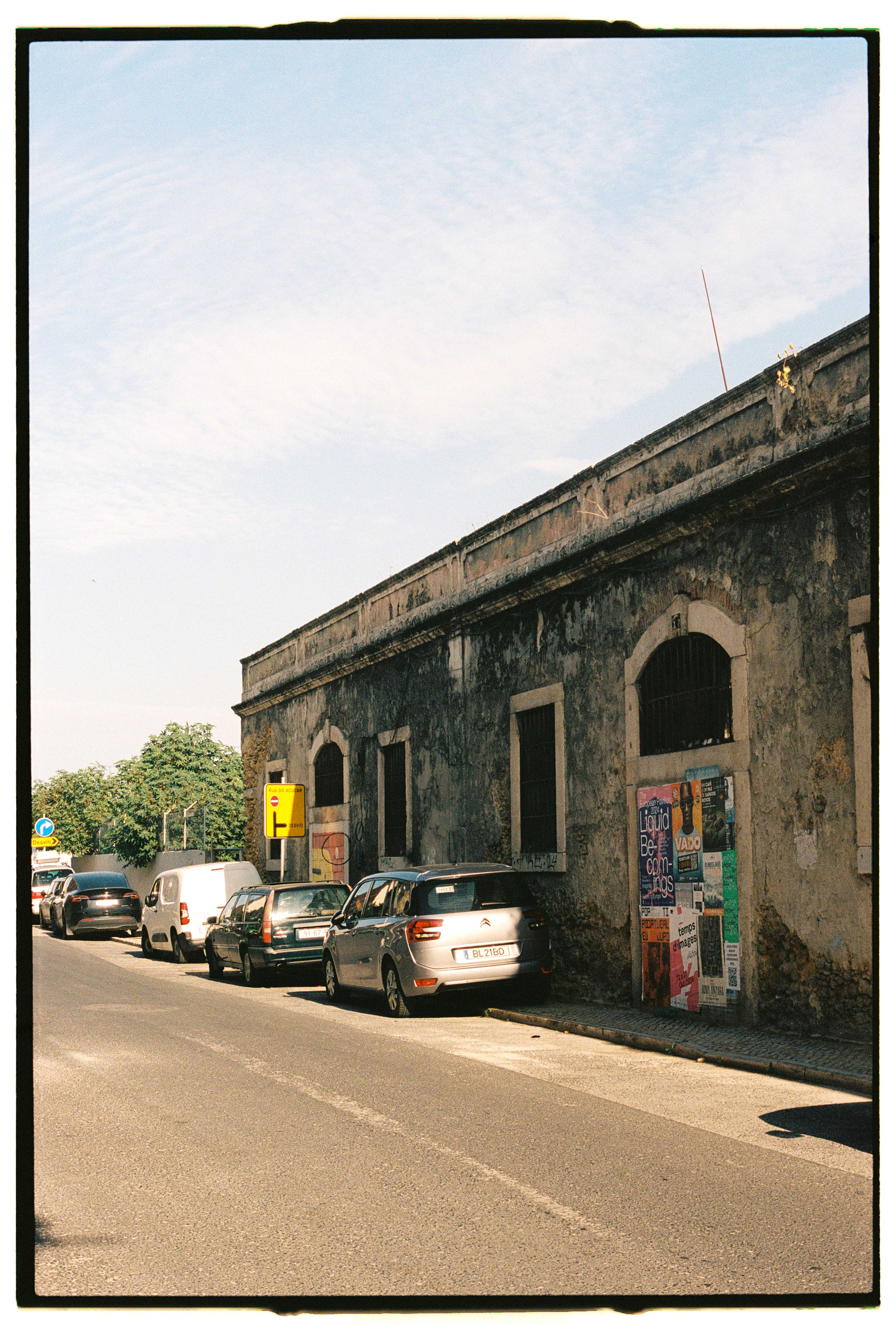
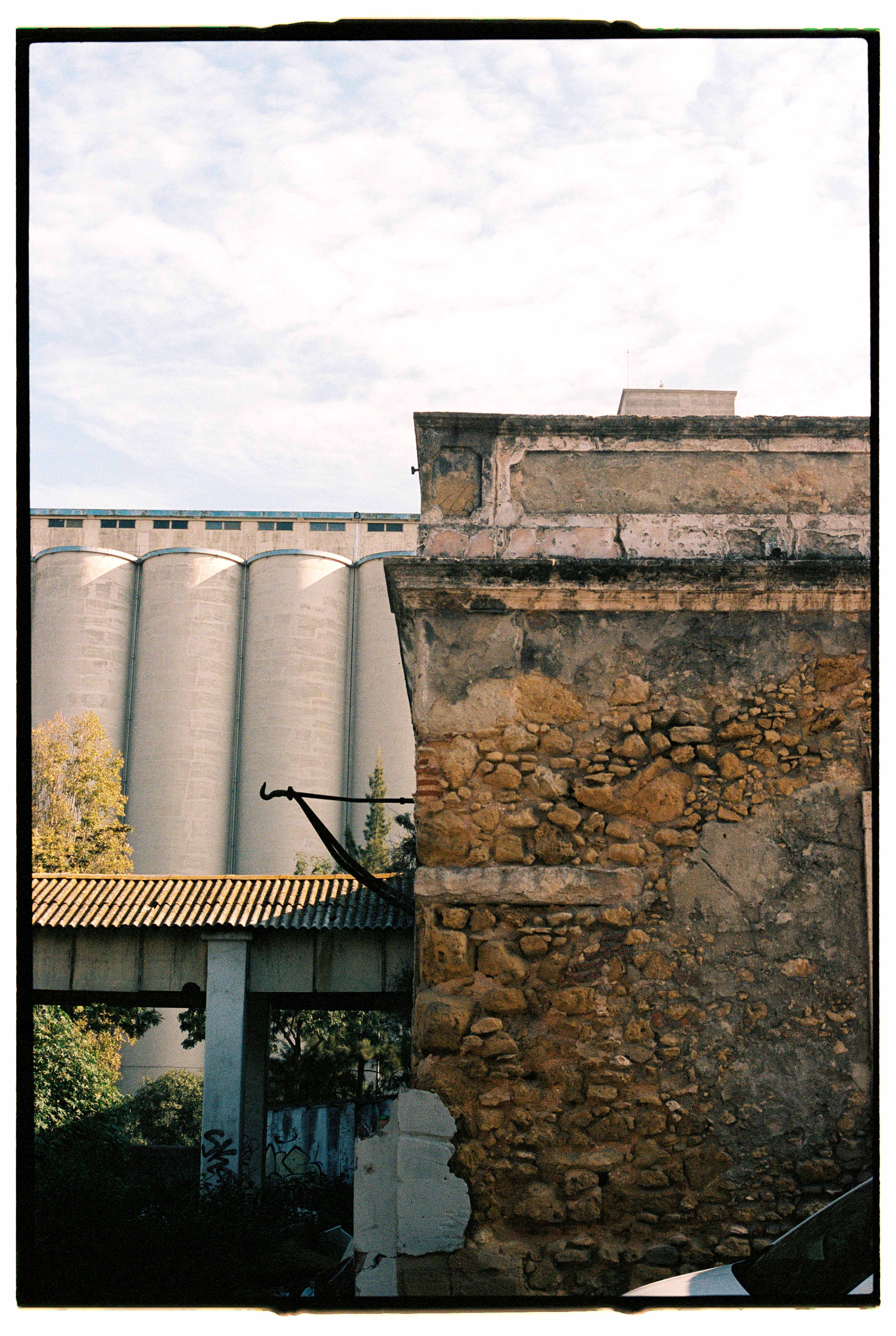
When handed a competition brief for 24 apartments on Rua do Beato, Lisbon - a site at the intersection of old, narrow streets and a new industrial area with multi-lane roads, massive silos and a pre-existing wall following the boundary of the plot - it seemed to us a very interesting challenge, both of architecture and of identity. How do we build in the face of such contradiction? How do we reconcile the intimate scale of the old city with the mechanical, unpersonal new industrial sprawl? It seemed a precious opportunity to think of a building that could establish a dialogue between the past and the future, to work with the collective memory, signs and symbols.
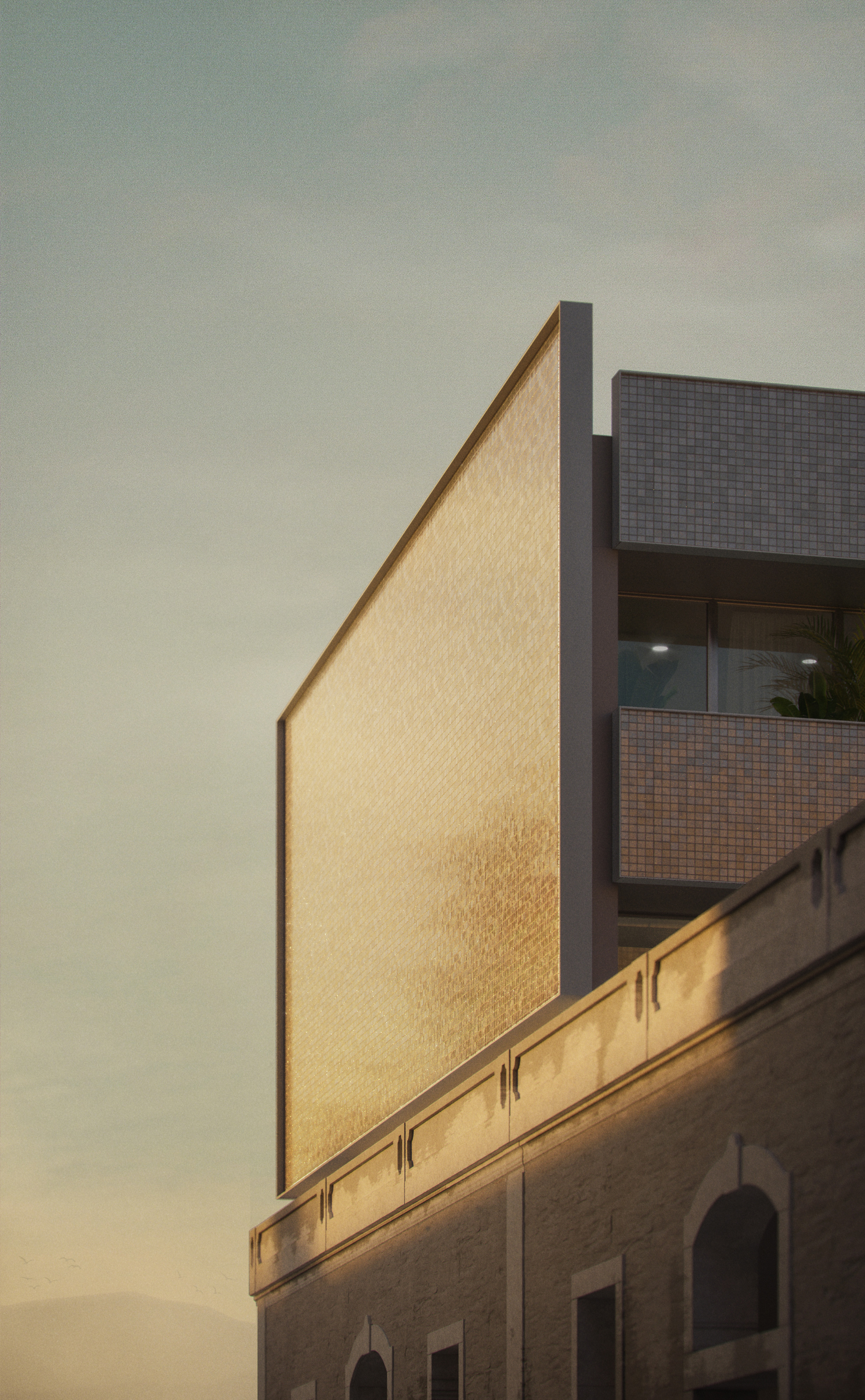
Our proposal aimed to create a sequence of patios or open/semi-open public spaces to mediate the relationship between the private and public realms, providing necessary privacy while still establishing a connection with the surrounding urban context. The design resulted in two volumes that rose above the existing wall.
Those two elements show up on either side of the building, blind, strange, gleaming in the sun, as if they were meant to be seen, but also not seen. At first, we could mistake them for billboards - the widespread, iconic structures that clutter the cities and that we’ve learned to love, or at least to live with. But then we might start to wonder. Advertising what? What’s the purpose of a billboard that doesn’t advertise anything? At most just reflections, just light dancing over the glass, over the Tejo River, casting shadows and shimmering ghostly forms.
What kind of absurdity is this? What does it mean?
Maybe it’s just a blind façade, a rather pragmatic, simple approach. Facades that are part of the city’s fabric, clad in the glazed tiles so characteristic of Lisbon. A small concession to the past, to tradition, benefiting from the workers who have built with these techniques for generations. A façade that is just a functional shield.
But maybe it’s something else. Maybe they’re hovering there with an effortless grace, light, like the air or a dream. A fragile thing, above a wall that’s just barely holding up. Floating, refusing to collapse, even when everything else around it seems to crumble.
A fight against weight, against gravity, against what came before. Or the opposite. A kind and subtle gesture meant to lift the burden of the wall beneath it, hovering above it not to overpower, but to coexist. Not to be seen or admired, but to create space for something else.
We attempted to answer the initial question, “Can architecture, in its built form, anticipate the conditions under which it will be viewed?” by establishing a dialogue with its users and passersby, using signs, symbols, and materials that were part of the very nature of the city itself. We tried to provoke a reflection, a question that hangs in the air like the beat of a distant drum, with no promise of an easy answer, but an invitation to keep coming back.
The project came in third place in the competition, which meant the jury took the time to write a comment about it. Their words were polite at first, praising the idea of creating “a set of public, semi-public, and private open spaces with a visual and spatial continuity between them, allowing various appropriations of the spaces.” But it didn’t matter much, the severe message came next in the cold final statement: “The impact of the blind gables on Rua do Beato and their urban integration were considered detrimental.”*6
It wasn’t so much that they didn’t like the idea—it was that they didn’t understand it at all.
We still believe that architecture can do what the other arts do: use common signs and symbols to guide and mediate the experience of its users, to shape their relationship with the space, with the environment, with each other.
As of now, we’ve failed to prove it. Good thing we’re young.
***
1. Von Moos, Stanislaus. “Focused Fuzziness.” In Twentyfive Herzog & de Meuron, edited by Stanislaus von Moos, Arthur Rüegg, p.29. Göttingen: Steidl, 2024.
2. Lütjens, Oliver. “#11 Lütjens Padmanabhan (CH).” Interview by Ana Catarina Silva. Arquitetura Entre Vistas Abroad. April 23, 2024.
3. Tarantino, Quentin. Interview by Charlie Rose. Charlie Rose. (New York: PBS, 1994)
4. Rothko, Mark. “The Artist’s Vision: Mark Rothko.” In The Artist’s Reality: Philosophies of Art, edited by Christopher Rothko, p.34-35. New Haven: Yale University Press, 2004
5. Turner, Alex. I Wanna Be Yours. Performed by Arctic Monkeys. AM. Domino, 2013.
6. Martins Dias, Isabel Maria. Concurso de conceção para a elaboração do Projecto do conjunto habitacional da Rua do Beato, em Lisboa – Relatório Final do Júri. P.20. Lisboa: IHRU, 2023.